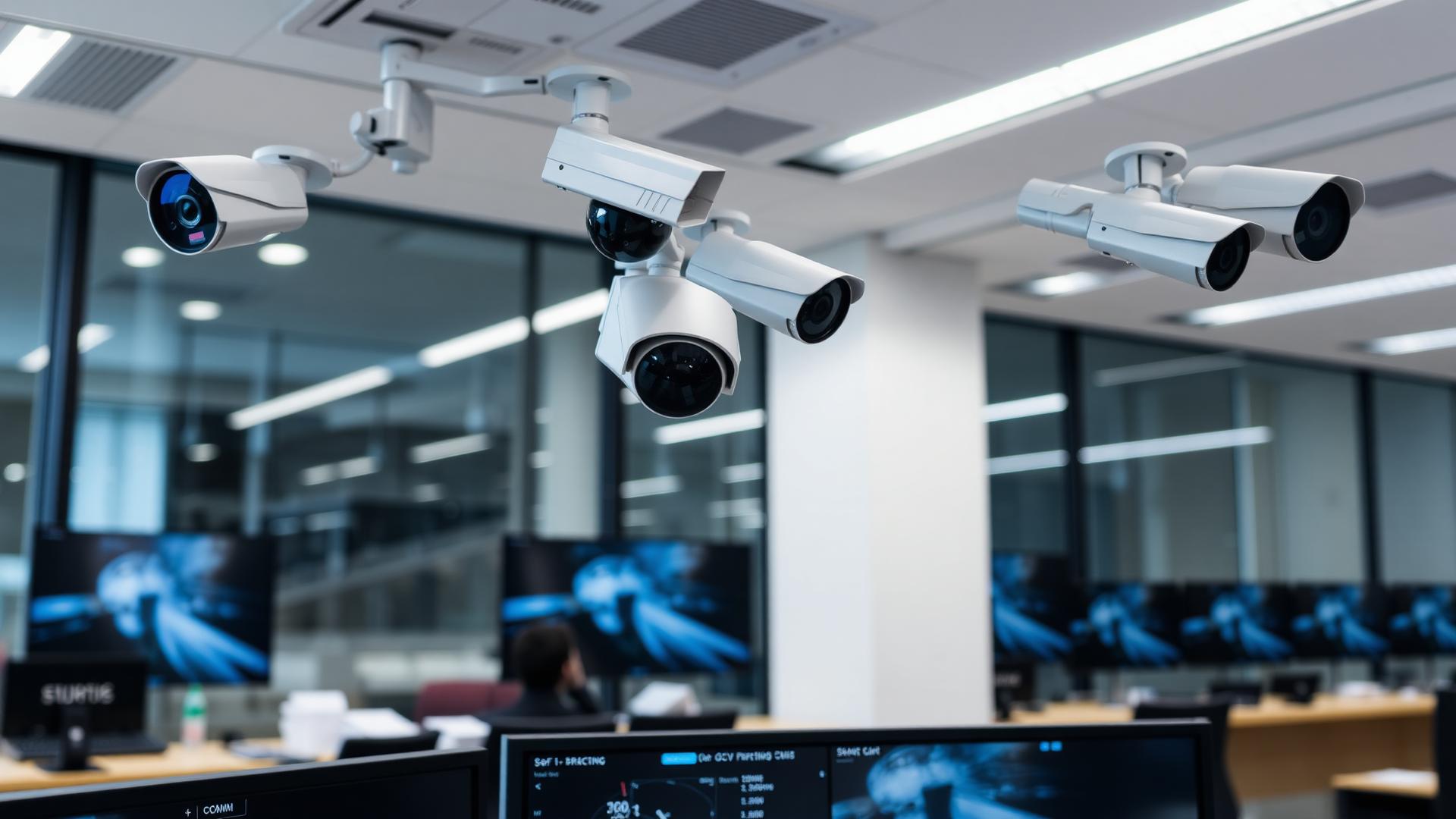
IP Cameras vs. Analog CCTV: Why Businesses Are Upgrading Their Surveillance
IP cameras deliver high-definition clarity (up to 12 MP), smart storage via H.265 compression, and full remote access over any network. Traditional analog CCTV systems are cheaper per camera but limited to lower resolutions, coaxial cabling, and local-only playback. For businesses that need security cameras capable of facial identification, licence-plate capture, and AI-powered analytics, IP-based surveillance cameras are the clear upgrade path. Read on for a full comparison of cost, image quality, storage, scalability and integration.
This guide was prepared by the SureTel Network Engineering Team with over 15 years of experience designing and deploying commercial CCTV installations across South Africa — from single-site offices to multi-branch retail and industrial surveillance networks.
Last Updated: March 2026
How Analog CCTV Works
Traditional analog CCTV systems have been the backbone of business surveillance for decades. These systems use analog cameras connected via coaxial cable (typically RG59 or RG6) to a DVR (Digital Video Recorder) that converts the analog signal into digital footage for storage.
Key Characteristics of Analog CCTV
- Resolution: Standard analog delivers 960H (960 × 480 pixels). HD-TVI, HD-CVI and AHD variants push this to 1080p or occasionally 5 MP
- Cabling: Coaxial cable with BNC connectors — separate power cables required for each camera
- Recording: DVR-based with limited compression (H.264 at best)
- Remote access: Basic — requires port forwarding and dynamic DNS configuration
- Camera count: Typically limited to 4, 8, 16 or 32 channels per DVR
Analog systems remain functional for basic coverage needs, but their limitations become apparent as businesses demand sharper detail, wider coverage areas, and remote management capabilities.
How IP Cameras Work
IP cameras (Internet Protocol cameras) are digital surveillance cameras that capture, compress, and transmit video over an Ethernet network or Wi-Fi. Each camera is a networked device with its own IP address, processing power, and — in many cases — onboard storage.
Key Characteristics of IP Cameras
- Resolution: 2 MP (1080p) to 12 MP+ (4K and beyond) — with some models reaching 32 MP for panoramic views
- Cabling: Standard Cat5e/Cat6 Ethernet with PoE (Power over Ethernet) — one cable carries video, data and power
- Recording: NVR-based (Network Video Recorder) with H.265/H.265+ compression
- Remote access: Native — cloud platforms, mobile apps, and browser-based viewing
- Camera count: Scalable from a handful to thousands via network switches
IP systems represent the current standard for commercial security cameras. For a deeper comparison of recording systems, see our NVR vs DVR guide.
Image Quality: Why Resolution Matters
The most compelling reason businesses upgrade from analog CCTV to IP cameras is image quality. Higher resolution doesn't just produce prettier pictures — it directly impacts whether footage is usable for identification, evidence, and operational intelligence.
What Higher Resolution Enables
- Facial identification: 4 MP+ cameras capture enough detail to identify individuals at 15–20 metres
- Number plate recognition: 2 MP cameras with the right lens can read plates at 25+ metres
- Digital zoom: High-resolution footage allows meaningful zoom-in during playback without pixelation
- Wider coverage: A single 8 MP camera can cover an area that would require 2–3 analog cameras
For businesses concerned about theft, fraud, or workplace incidents, the ability to produce clear, court-admissible evidence is a significant advantage of IP-based surveillance cameras.
Storage & Compression Compared
A common concern when upgrading to higher-resolution IP cameras is storage consumption. However, modern compression technology has largely eliminated this disadvantage.
| Feature | Analog CCTV (DVR) | IP Cameras (NVR) |
|---|---|---|
| Compression | H.264 or MJPEG | H.265 / H.265+ |
| Storage per camera/day (1080p, 24/7) | ~25–40 GB | ~8–15 GB (H.265+) |
| Smart recording | Basic motion detection | AI-triggered recording (person, vehicle, line-cross) |
| Storage location | Local DVR hard drives only | NVR, NAS, cloud, or camera SD card |
| Redundancy | Limited — RAID on DVR | NVR + NAS + cloud for multi-tier backup |
| Retention scaling | Upgrade DVR or reduce quality | Add NAS storage or cloud tier seamlessly |
H.265+ compression reduces storage by up to 80% compared to H.264 at the same resolution — meaning a 4 MP IP camera often uses less storage than a 1080p analog camera running H.264. AI-triggered recording further reduces storage by only writing footage when relevant events occur.
Cabling & Infrastructure
Cabling is where IP cameras deliver a hidden cost advantage that many businesses overlook.
Analog CCTV Cabling
- Each camera requires a dedicated coaxial cable (video) plus a separate power cable
- Maximum cable run: ~300 metres for HD-TVI before signal degradation
- Power supplies needed at camera locations or via centralised power boxes
- Adding cameras means pulling new coax runs
IP Camera Cabling
- Single Cat5e/Cat6 Ethernet cable carries video, data, and power (PoE)
- Maximum cable run: 100 metres per segment — extendable with PoE switches or extenders
- PoE switches centralise power delivery and management
- Adding cameras requires only a network port and Ethernet drop
For new builds and office fit-outs, IP cabling is simpler, cheaper, and future-proof. For businesses with existing coax infrastructure, hybrid systems allow a phased transition.
Remote Access & Mobile Viewing
Modern businesses need to monitor their premises from anywhere — not just from a control room. This is where IP cameras dramatically outperform analog CCTV.
Analog Remote Access
- Requires port forwarding, dynamic DNS, and router configuration
- Limited to basic live viewing — playback and search are unreliable remotely
- Security risk: exposed ports are vulnerable to unauthorised access
IP Camera Remote Access
- Cloud-based platforms with encrypted P2P connections — no port forwarding needed
- Full live viewing, playback, search, and export from mobile apps
- Multi-site management from a single dashboard
- Push notifications for AI-triggered events (person detected, line crossed, loitering)
For business owners and security managers who need security cameras accessible from their phone while travelling, IP systems deliver this natively. Learn more in our remote camera monitoring guide.
Scalability for Growing Businesses
Analog DVRs are limited to fixed channel counts — 4, 8, 16, or 32. Once you fill a DVR, adding more cameras means buying another DVR, pulling more coax, and managing a second recording platform.
IP cameras scale through the network. Adding a camera means connecting it to a PoE switch and registering it on the NVR or VMS (Video Management System). Enterprise NVR platforms support hundreds or thousands of cameras across multiple sites — all managed from a single interface.
This scalability is critical for businesses expanding to new branches, warehouses, or retail locations. A unified surveillance camera platform ensures consistent security policies across every site.
Smart Features & AI Analytics
One of the most transformative advantages of modern IP cameras is onboard AI processing. These aren't just cameras — they're intelligent sensors that analyse video in real time.
AI-Powered Capabilities
- Person & vehicle detection: Distinguish between humans, vehicles, and irrelevant motion (animals, shadows)
- Line crossing & intrusion detection: Trigger alerts when someone enters a restricted zone
- Facial recognition: Match faces against watchlists or VIP databases
- People counting: Track foot traffic for retail analytics and occupancy management
- Licence plate recognition (ANPR): Automate vehicle access control at gates and parking areas
- Loitering detection: Alert security when someone remains in an area beyond a time threshold
These features transform security cameras from passive recording devices into proactive security tools — preventing incidents rather than just documenting them. For a deeper look, see our guide on AI & video analytics for business.
Cost Comparison: IP vs. Analog
| Cost Factor | Analog CCTV | IP Camera System |
|---|---|---|
| Camera unit cost | R 800 – R 2,500 | R 1,500 – R 8,000+ |
| Recorder | DVR: R 2,000 – R 6,000 | NVR: R 3,500 – R 15,000+ |
| Cabling per camera | Coax + power: R 25–40/m | Cat6 (PoE): R 12–20/m |
| Power infrastructure | Separate PSUs or power boxes | PoE switch (centralised) |
| Installation labour | Higher (dual cable runs) | Lower (single cable per camera) |
| Storage cost/TB (annual) | Higher (H.264 bloat) | Lower (H.265+ efficiency) |
| Remote access platform | Free but limited / insecure | Free cloud apps (Hik-Connect, Dahua DMSS, etc.) |
| Total 16-camera system | R 25,000 – R 55,000 | R 45,000 – R 120,000+ |
While the upfront cost of an IP system is higher, the total cost of ownership over 3–5 years is often comparable — or lower — when you factor in reduced cabling costs, lower storage consumption, fewer cameras needed (higher resolution = wider coverage), and avoided security incidents thanks to AI analytics.
Hybrid Systems & Upgrade Path
Businesses don't need to replace their entire analog CCTV system overnight. Hybrid DVR/NVR recorders accept both analog and IP camera inputs, allowing a phased migration:
- Phase 1: Replace the DVR with a hybrid NVR that supports existing analog cameras
- Phase 2: Add new IP cameras to cover blind spots or high-priority areas
- Phase 3: Replace aging analog cameras with IP models as they reach end-of-life
- Phase 4: Transition to a fully IP-based system with centralised NVR or cloud storage
This approach spreads capital expenditure over multiple budget cycles while immediately gaining the benefits of IP technology where it matters most. Contact SureTel for a CCTV installations assessment to plan your upgrade.
When Analog CCTV Still Makes Sense
Despite the advantages of IP, there are scenarios where analog CCTV remains practical:
- Very small sites: A 4-camera system for a small shop with no remote access needs
- Existing coax infrastructure: Buildings already wired with coax where re-cabling is impractical
- Minimal budget: Where the lowest upfront cost is the only priority
- Simple deterrence: Visible cameras for basic deterrent effect without analytical requirements
For these use cases, HD-TVI or HD-CVI analog systems deliver acceptable results. However, even these scenarios benefit from a hybrid recorder to future-proof the investment.
Why Businesses Are Upgrading to IP
South African businesses are upgrading their surveillance cameras to IP for clear, measurable reasons:
- Evidence quality: 4 MP+ footage is dramatically more useful for SAPS cases, insurance claims, and disciplinary proceedings
- Operational visibility: Remote viewing from any device gives owners and managers real-time oversight
- Insurance requirements: Many insurers now require HD security cameras with minimum retention periods — IP systems meet these requirements more easily
- Integration: IP cameras integrate with access control, alarm systems, and building management platforms via open standards
- Reduced false alarms: AI-based detection eliminates the constant false alerts that plague basic motion-detection systems
- Multi-site management: Businesses with multiple branches can view all sites from a single platform
The gap between analog and IP continues to widen. For any business investing in a new CCTV system or upgrading an aging one, IP is the standard choice. For guidance on selecting the right system and installer, explore our CCTV camera types guide and how to choose a CCTV company.
How SureTel Delivers Professional CCTV Solutions
SureTel provides end-to-end CCTV installations for South African businesses — from site assessment and network design to installation, configuration, and ongoing support. Our team designs IP camera systems that integrate with your existing network infrastructure, ensuring reliable performance without impacting business connectivity.
Whether you're upgrading from analog, expanding an existing IP system, or deploying surveillance at a new site, SureTel's network engineers design solutions that deliver the clarity, storage efficiency, and remote access modern businesses demand.
Ready to upgrade your surveillance? Request a free CCTV site assessment and discover what IP cameras can do for your business security.